Wheel Alignment vs Wheel Balancing: What’s the Difference?
Ask ten motorists what the difference is between wheel alignment and wheel balancing and most will use the terms interchangeably. They are, in fact, two completely separate jobs, done with different equipment, to fix different problems. If you run a fitment centre or workshop, knowing exactly where one ends and the other begins is the difference between fixing a customer’s complaint the first time and having them come back annoyed.
The short answer
Wheel balancing corrects the weight distribution of a wheel-and-tyre assembly so it spins smoothly at speed. Wheel alignment corrects the angles at which the tyres meet the road so the vehicle tracks straight and wears its tyres evenly. Balancing is about the wheel; alignment is about the suspension geometry.
What wheel balancing actually does
No tyre-and-rim combination is perfectly even in weight. Even a few grams of imbalance becomes a noticeable vibration once the wheel is spinning at 100 km/h. A wheel balancer spins the assembly, measures exactly where the heavy spot sits, and tells the technician how much corrective weight to add and where. Get it wrong and the customer feels a vibration through the steering wheel (front wheels) or the seat (rear wheels), tyres cup and wear unevenly, and wheel bearings and suspension components take a pounding they were never designed for.
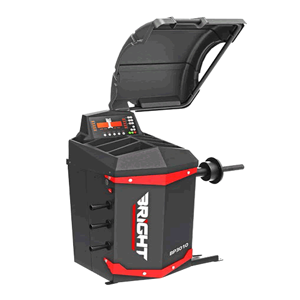
Most passenger work is handled on a laser-guided balancer such as the BP3010 wheel balancer with laser or the BP75 with laser pointer, which shows the operator exactly where to clip the weight. Truck fitment centres need a heavier machine with a wheel lift, like the BP460B truck wheel balancer, because a truck wheel is simply too heavy to lift onto the shaft by hand all day.
What wheel alignment actually does
Alignment has nothing to do with the wheel’s weight and everything to do with angles — camber, caster and toe. When these drift out of the manufacturer’s specification (usually from hitting a pothole or a kerb, or from worn suspension parts), the tyres no longer point exactly where the car is travelling. The result is a car that pulls to one side, a steering wheel that sits off-centre, and tyres that wear on one edge far faster than the other.
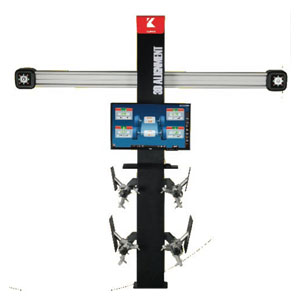
Correcting it requires a wheel alignment machine that measures each wheel’s angles against the vehicle’s spec and guides the technician through the adjustments. A modern 3D system such as the K1800 3D wheel alignment system reads all four wheels at once and shows live readings as the technician turns the adjusters.
How to tell which one a car needs
Use the symptom to point you to the job:
- Vibration that gets worse with speed, felt through the wheel or seat → balancing.
- Car pulls to one side on a straight, level road → alignment.
- Steering wheel not centred when driving straight → alignment.
- Tyres worn evenly across the tread but the car shakes → balancing.
- Tyres worn on one edge only → alignment (and probably worn suspension to check too).
In practice the two often go together. Fitting a new set of tyres is the natural moment to balance every wheel and check the alignment, which is why most fitment bays run a balancer and an alignment machine side by side.
Do you need both machines?
If you fit tyres, yes. Balancing is a job you will do on every single tyre you sell — it is unavoidable and high-volume, so a reliable balancer pays for itself quickly. Alignment is a higher-value add-on service that many customers will pay for at the same visit, and it is one of the few services a tyre shop can offer that the informal market cannot. A workshop that offers both captures the full job instead of sending the customer down the road for the half it cannot do.
You can see the full range of wheel balancers and wheel alignment machines and brake lathes in our catalogue — every machine is supplied new with warranty, and prices include VAT. If you are not sure which model suits your bay, get in touch and we will talk you through it.
Further reading: if you are fitting out a bay from scratch, see our equipment checklist for starting a tyre fitment centre.
Posts Widget
-
1
-
2

-
3
-
4
Automotive Equipment, Tools & Accessories
Enterprise number K2024519484
VAT registration number 9003172336
Copyright © 2026 AETANDA. All rights reserved.

One thought on “Wheel Alignment vs Wheel Balancing: What’s the Difference?”
Pingback: Tyre Fitment Centre Equipment Checklist | AETANDA